1. Define what you need, without merging different rules
Write your requirement as a short list of ingredients or practices that matter to you. Vegetarian, vegan, halal, gluten-related restrictions and a food allergy are not interchangeable labels. Someone avoiding meat may still eat eggs, while another traveler does not; someone avoiding pork may also need information about certification and preparation. The restaurant cannot infer those distinctions from the word healthy.
Explain an allergy as an allergy, not simply as a dislike. If the consequence of a mistake is serious, discuss travel preparation with your clinician before departure. Make your needs clear in Korean as well as your own language, and do not rely on a quick machine translation of a long medical history at a busy counter.
2. For vegetarian or vegan meals, ask below the garnish
A bowl of vegetables can sit on a non-vegetarian broth, and a side dish can contain seafood-based seasoning. Ask about stock, sauce, fish sauce, meat, egg and dairy according to your own requirements. Bibimbap or gimbap can be useful dishes to investigate, but their names alone do not promise a vegetarian or vegan recipe. Removing the visible meat may leave the sauce or broth unchanged.
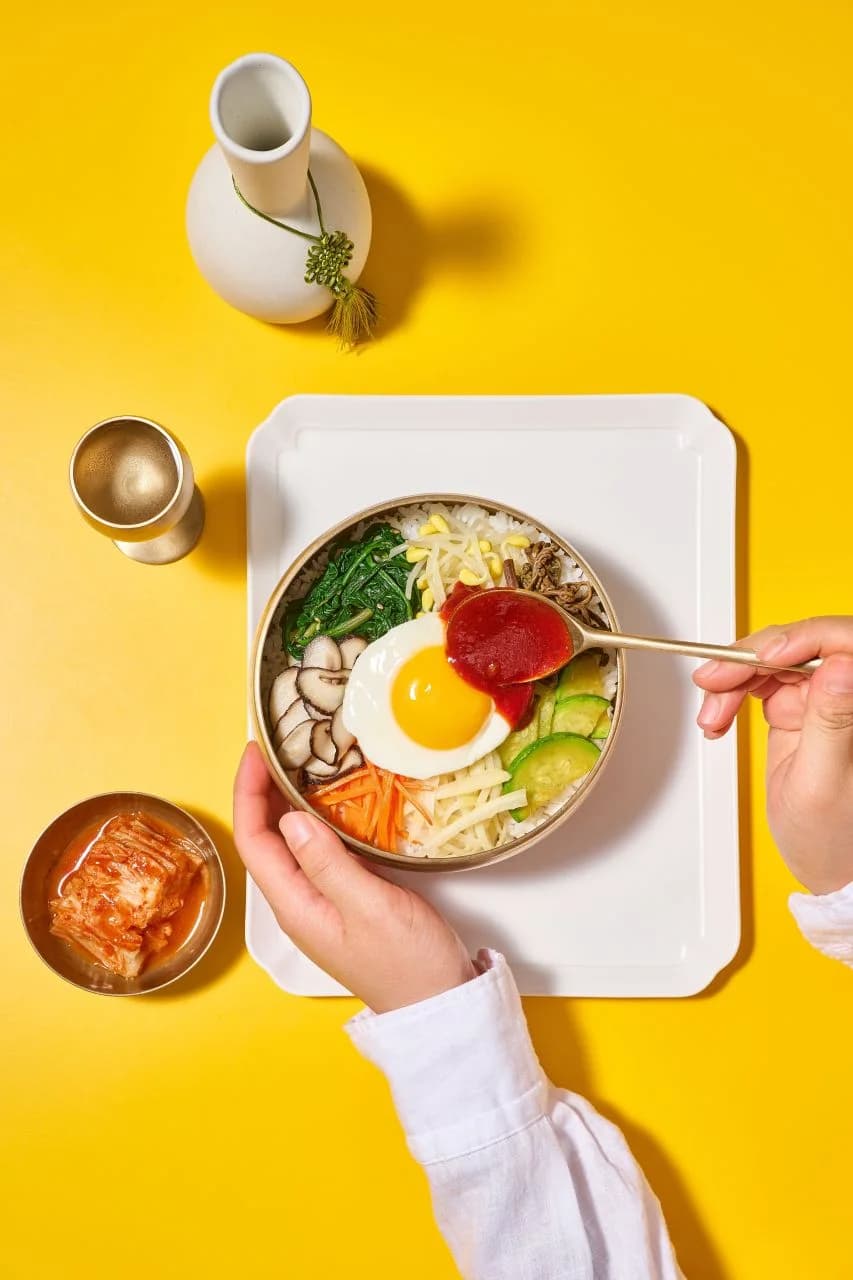
Check a restaurant’s current menu and ask whether it can prepare the dish appropriately before ordering. If the answer is uncertain, choose a clearly explained alternative instead of negotiating after the meal arrives. The bibimbap photograph on this guide illustrates a Korean meal; it is not a claim that the pictured ingredients meet any reader’s dietary rules.
3. For halal dining, read the certification category
KTO separates four restaurant categories. Halal Certified refers to certification by an accredited body; Self-certified is the Muslim owner’s own halal assurance. Muslim Friendly means some halal dishes are offered and alcohol may be sold. Pork free does not mean the restaurant offers a halal menu, and alcohol may also be sold. These labels should not be treated as equivalent levels of certification.
Look up the current restaurant listing and clarify the specific menu you intend to order. Ask about any advance reservation requirement and whether the preparation meets your own observance. A hotel buffet can contain different kinds of dishes, so a favorable label for a venue is not an instruction to eat everything on display. Decide your required standard before arriving hungry.
| KTO label | Meaning | Not equivalent to |
|---|---|---|
| Halal Certified | Accredited halal certification | A mere pork-free statement |
| Self-certified | Muslim owner’s halal assurance | Independent accredited certification |
| Muslim Friendly | Some halal dishes; alcohol may be sold | All dishes being halal |
| Pork free | No pork; no halal-menu assurance | Halal certification |
4. For allergies, ingredients and cross-contact are separate checks
Ask about shared grills, fryers, utensils, preparation surfaces and sauces when these are relevant to your allergy plan. Staff saying that a dish has no visible nuts, for example, does not establish how it was prepared. If the kitchen cannot give a clear answer, do not treat reassurance from a food photograph or another customer as verification.
CDC recommends pretravel medical review for severely allergic travelers, an individual emergency plan and access to prescribed medication. Follow your clinician’s instructions and check relevant medication-import requirements separately. Keep essential medication accessible rather than in checked or stored luggage. For an emergency in Korea, call 119 and provide your location; this article is not a substitute for medical care or your prescribed response plan.
5. Use short questions the kitchen can answer
For a meat-and-seafood check, show “고기나 해산물이 들어가나요?”—does this contain meat or seafood? Ask “육수에 어떤 재료가 들어가나요?”—what ingredients are in the broth?—rather than relying on the main dish name. For halal information, “할랄 인증을 받았나요?” asks whether there is halal certification; follow up on the actual certifier and menu.
For an allergy, use a professionally checked card naming your exact allergen and explaining your requirements. A generic phrase cannot cover every allergy or severity. Ask staff to consult the kitchen if necessary, and wait for a meaningful answer before ordering. Nodding or saying yes to be polite is not enough when the key question has not been understood.
6. Build a fallback before the day starts
Identify a suitable meal option near your accommodation and another near the day’s main attraction, then confirm the current menu and opening. Bring a backup you can personally verify, subject to customs and storage requirements. Travelers with complex needs may prefer accommodation with appropriate food-preparation facilities, but the facilities and shared-equipment conditions must also be checked.
Keep your requirements, restaurant details and emergency information available offline. Reconfirm at each meal because ingredients and staff can change. If the answer is unclear, choose the fallback without apologizing for protecting a genuine need. The goal is a usable plan with clear limits, not a list of dishes labeled safe by an article that has never inspected the kitchen.
Sources & verification
Prepared by Gollaba using the sources below. Planning suggestions are editorial judgments, not claims of a personal visit.
- Korea Tourism Organization — vegetarian travel ↗Source checked:
- Korea Tourism Organization — Muslim-friendly restaurant categories ↗Source checked:
- CDC Yellow Book 2026 — severely allergic travelers ↗Source checked:
- Korea Tourism Organization — disaster safety and emergency contacts ↗Source checked: