
Start with your hotel, not a train name
Save your hotel’s address and its own access instructions before departure. An “Osaka” ticket does not mean a transfer to every Osaka hotel. Compare the final walk and any local connection as part of the journey, especially with luggage or children.
The table is an editorial starting point, not a claim that one service is always fastest or cheapest. If your hotel is outside these areas, use its nearest station as your destination rather than forcing an extra transfer through a familiar station name.
| Hotel area | First options to compare | What decides the choice |
|---|---|---|
| Namba | Nankai Airport Express / Rapi:t | Arrival at Nankai Namba and the onward walk |
| Osaka Station / Umeda | JR HARUKA / Osaka Station limousine bus | Exact station exit or bus stop nearest the hotel |
| Tennoji | JR HARUKA and other JR routes | Actual train time, fare and hotel access |
| Elsewhere in Osaka | Operator route search to the hotel’s station | Full route, not just the airport leg |
Get from your terminal to the departure point
Kansai Airport Station connects to the second floor of Terminal 1 and Aeroplaza. For a train after arrival at Terminal 2, use the free shuttle to Aeroplaza, then follow the station signs. The airport gives 7–9 min for the shuttle ride; walking and waiting are extra.
For a limousine bus, check the route’s boarding terminal. Some services leave Terminal 2 directly, so transferring to the railway station first can be unnecessary. Keep the terminal name visible alongside your booking, rather than saving only the airport code KIX.
- Confirm Terminal 1 or Terminal 2 on the flight information.
- Finish arrival procedures and collect luggage before estimating a usable departure.
- Follow signs for the selected railway operator or the specific bus route.
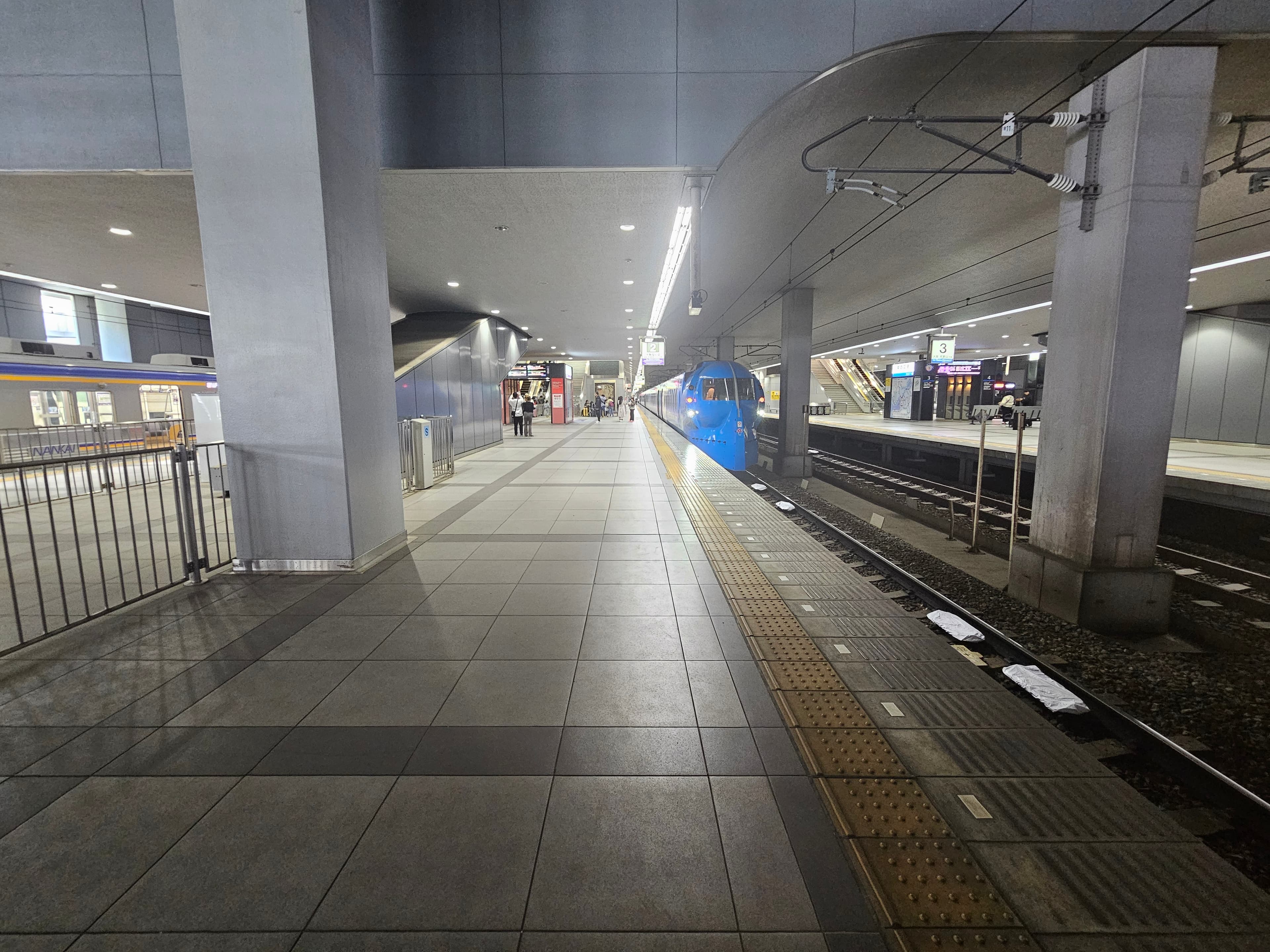
Namba: Airport Express or Rapi:t?
Nankai quotes about 45 minutes for Airport Express and as little as 34 minutes for Rapi:t between Kansai Airport and Namba. These are train journey figures, not immigration-to-hotel times. A shorter ride can lose its advantage if you wait longer for departure.
Airport Express requires an ordinary train ticket. Rapi:t also needs a limited-express ticket. The official regular-seat supplement displayed when checked was JPY 700, in addition to the ordinary fare; it is not the total airport-to-Namba price. Bundled digital tickets and ticketless supplements have different purchase rules.
Compare the complete fare and seating arrangement before paying. For Nankai’s digital-ticket flow, follow the emailed link, select the train/seat, and use the specified QR gate procedure. Do not assume every third-party voucher works at the gate without exchange.
Umeda or Tennoji: understand the HARUKA offer
HARUKA serves Tennoji, Osaka and Shin-Osaka directly from Kansai Airport. They are separate destinations: select the one on your hotel’s access instructions. Osaka Station is the relevant rail arrival to investigate for the Umeda area; a bus may suit a hotel near its particular stop better.
The JR-WEST discounted one-way product requires a foreign passport and Temporary Visitor status. It is not a general fare for Japanese nationals or every resident of Japan. Carry your passport and check the collection procedure for the sales channel you use. A reservation confirmation is not automatically a ready-to-use ticket.
The prices below were displayed on the official pages checked on 6 September 2026, not confirmed checkout quotes. The HARUKA page itself dates its information to 5 February 2025, so reconfirm before purchase. Other JR routes may also suit your trip; this table does not rank every train by price.
| One-way product | Published adult amount | Scope |
|---|---|---|
| HARUKA discounted ticket to Tennoji | JPY 1,300 | Eligibility and purchase/collection rules apply |
| HARUKA discounted ticket to Osaka / Shin-Osaka | JPY 1,800 | Not the unrestricted regular fare |
| Osaka Station/Umeda limousine bus | JPY 1,800 | Check the exact stop and selected service |
When the Umeda bus is worth considering
The operator lists around 60 minutes from Terminal 1 to Osaka Station (Hankyu Sanban Gai), with extra time from Terminal 2. Its route is first come, first served rather than seat-reservation based. Check the stop column for your chosen departure: not every bus serves every listed stop.
Treat the timetable as a planning input, not a guaranteed hotel arrival. Compare the walk from the actual stop with the rail alternative. If avoiding transfers matters more than a small difference in fare, that final segment may settle your choice.
For wheelchairs, unusual luggage or assistance, use the operator’s specific guidance before choosing a service. A luggage compartment does not establish that every bag or mobility device can be accepted on every bus.
Plan a fallback for a delayed flight
Search the timetable for your travel date only after distinguishing landing time from the time you can leave the arrivals area. If the planned departure is the last practical connection, decide in advance what you will do if you miss it. Do not assume that all services run overnight.
The Umeda route includes a specially marked late-night bus with cashless payment only, and warns that no extra bus will be added when it is full. That makes it a possible service to verify, not a guaranteed rescue option.
If scheduled transport is no longer usable, ask the airport information desk about current options, or compare a confirmed transfer with nearby accommodation. For a booked car, get the meeting point, delay policy, waiting allowance and final destination in writing; do not infer them from “airport transfer.”
Three ways to make the decision
A solo traveller staying near Nankai Namba can compare the next Airport Express with the next usable Rapi:t, including the whole fare. Paying for a shorter ride makes less sense if waiting cancels the time saved.
Two eligible visitors staying near Tennoji can use the published HARUKA discount as one candidate, then compare collection effort and onward walking. Eligibility is checked per traveller; one qualifying passenger does not make the whole group eligible.
A family staying near a named Umeda bus stop should compare a bus-to-hotel walk against the railway exit route. These are planning examples, not measured journeys or promises about queues. Price all passengers and any separate onward transport before deciding.
Before you pay, and before you return
For the return trip, work backwards from your airline’s required airport arrival and check-in deadlines. Use a train or bus arriving at the correct terminal with room for the connections you actually need. A station arrival is not a Terminal 2 check-in arrival.
Keep the official route links below with your hotel details. Recheck service notices and the date-specific timetable before travelling; this guide’s verification date is not a live service-status update.
- Correct destination station or bus stop and hotel entrance.
- Terminal 2 shuttle and walking time, where applicable.
- Ordinary fare, supplement, discount eligibility and all passengers included.
- Ticket collection, QR use, seat selection and change conditions checked.
- A workable delay fallback and the correct return terminal.
Sources & verification
Prepared by Gollaba using the sources below. Planning suggestions are editorial judgments, not claims of a personal visit.
- Kansai Airports — Train access ↗Source checked:
- Kansai Airports — Terminal 2 shuttle ↗Source checked:
- Kansai Airports — Bus boarding ↗Source checked:
- Nankai — Train services and timetables ↗Source checked:
- Nankai — Rapi:t fare and seating ↗Source checked:
- Nankai — Digital tickets ↗Source checked:
- JR-WEST — HARUKA one-way ticket ↗Source checked:
- KATE — Osaka Station route ↗Source checked:
- KATE — Boarding, baggage and assistance ↗Source checked: